

In October, OpenAI announced shopping within ChatGPT. This feature will help consumers find products, and allow them to make purchases without ever leaving ChatGPT's interface. With ChatGPT already exceeding 800 million weekly active users, it's a massive opportunity for brands.
Select merchants in the US can already submit their product data to OpenAI. Shopping and Instant Checkout will roll out to more merchants and expand to countries outside the United States throughout 2026. To get ahead, retailers should start preparing now.
Table Overview
Refer to the official field reference for the latest guidance on tables and fields.
Most fields share standard names, similar to structured JSON-LD data or Google Shopping's product data specification. You may be able to re-map some of your Google product feed to fill out most of your OpenAI product feed. However, some fields are unique to OpenAI, which we recommend including as they likely will boost the performance of your listing.
Fields are grouped into 15 tables which merchants will need to submit:
- OpenAI Flags: Two simple True/False flags that control whether a product is visible in ChatGPT, and whether in-chat Instant Checkout is available.
- Basic Product Data: Core data including a unique ID, title, description and URL.
- Item information: Defines key product properties like the category, brand, material, dimensions, condition and age group.
- Media: Visual assets. OpenAI hasn't specified a maximum number of additional images you can include. You can include 3D models (similar to Google's spec). Unique to OpenAI is optional product videos.
- Price & Promotions: Current price, sale price and sale dates. Unique to OpenAI is an optional pricing trend, like "Lowest price in 6 months". It's unclear if this is a freeform field.
- Availability & Inventory: Current stock status, availability dates and pickup methods.
- Variants: Data on size, gender and color (or other variants). Optionally you can include three custom options which will help users find specific products. For example, "Cap_Type", with the options like "Snapback" or "Fitted".
- Fulfillment: Shipping options and delivery estimates.
- Merchant Info: Store name, URL, privacy policy and terms of service.
- Returns: Return policy, window and deadlines. You must include a link to your return policy and the return window in days (e.g. "30" for a 30-day return policy).
- Performance Signals: Aggregate popularity score, like 4.7/5. You can include the return rate. It's unclear how the return rate will be used.
- Compliance: Disclaimers such as 'Contains lithium battery' that OpenAI should surface to customers.
- Reviews and Q&A: Aggregated review statistics and frequently asked questions. Providing FAQ and raw review data is new and recommended; it will likely help ChatGPT answer users' questions about your product.
- Related Products: Products commonly bought together or substitutes. OpenAI will use this to cross-sell and suggest complementary goods.
- Geo Tagging: Restrict products to certain countries or set regional pricing and availability. You can define regions at a country or state/province/region level (ISO-3166-2).
File Formats
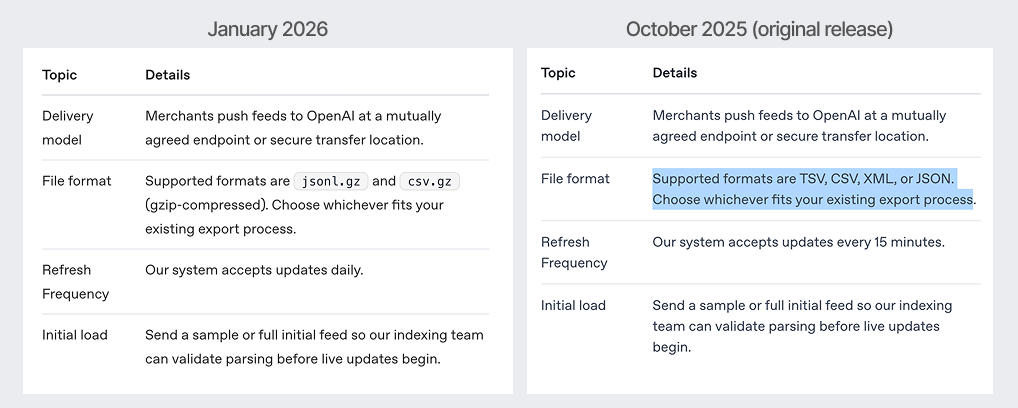
The currently supported file formats are compressed JSON lines (jsonl.gz) or compressed CSV (csv.gz).
Note that the supported file formats have changed since OpenAI's original announcement. While TSV and XML were in the initial spec announcement, they have since been removed.
Your product data feed must be compressed using Gzip. Presumably early users' uncompressed data was too large to be dealt with efficiently.
Update Frequency
OpenAI accept updates every 15 minutes. Make use of this to update availability and prevent overselling.
Currently, it seems there is no support for incremental updates; the full feed must be re-submitted.
Security
Once you join OpenAI's merchant program, you will receive a specific submission location. You should only submit data to this endpoint. Do not host your data available at a public endpoint on your website.
Prohibited Products
OpenAI will refuse product listings for any adult content, age-restricted products (alcohol, gambling), weapons, prescription medications, financial products. Violations could result in a ban from selling on ChatGPT.
OpenAI Merchant Signup
To get started, you must sign up to OpenAI's merchant program. You can sign up here: ChatGPT Merchant Signup.
While rollout is currently limited to US merchants, international brands should still sign up to gain access early when it becomes available.
It's likely that larger merchants will be invited first.
will be integrated automatically through existing partnerships and do not need to fill out the manual signup form.