

Summary
To start selling products on ChatGPT and Gemini in 2026, brands should act now. We've organised these steps into a baseline, a good, and great readiness level:
Readiness Level | Suggested actions |
|---|---|
Baseline |
|
Good |
|
Great |
|
Read on for more detail, or join our newsletter or book a call for more information.
Introduction
2026 will bring major changes to how brands sell products through AI platforms like ChatGPT, Gemini and Claude.
Three days ago, a Google-led alliance of payment processors, ecommerce platforms and major retailers announced the Universal Commerce Protocol (UCP). It gives merchants a way to host a single API which enables any AI tool (including Gemini) to find products, add them to a cart, and pay securely.
OpenAI have already released 'Instant Checkout', which lets customers purchase products without leaving ChatGPT. Last last year, they published their Product Feed Spec, outlining how retailers can get their products into ChatGPT. Both are already rolling out to merchants.
Advertising in AI chats is also coming in 2026. At NRF, Google launched branded 'AI Business Agents'. In Google search results, customers will be able to open a chatbot that you've trained on your products, policies, and brand. Through UCP, you'll also be able to send exclusive discounts to customers searching for your products through AI, and traditional 'featured product' advertising is widely expected to be a core part of AI product search.
To take advantage of these opportunities, merchants should act now. First, they should start to preparing data they'll need send to AI platforms, and building support for in-chat checkout to be listed early. Improving structured data will help AI models display products to users. Tracking metrics like visits, checkouts and conversions from each model will help merchants improve their listings over time.
How important is agentic commerce?
With AI, it's hard to know what's hype and what's real.
Some of the more 'agentic' announcements seems far-fetched. I doubt that users will start delegating purchasing decisions to AI agents soon. Consumers are concerned about security, and allowing AI to make purchases without final user confirmation seems risky.
That said, no brand can ignore AI's massive, growing audience. ChatGPT surpassed 800 million weekly active users in October. Up to 50% of consumers already use ChatGPT for shopping-related questions. Click rate in Google is down 30% for some businesses as consumers shift to AI for answers.
Supporting product search, to get your products in front of AI users, seems inevitable for retailers. Adding support for in-chat checkouts will reduce purchase friction and increase conversion, so we're confident that it will be important as well.
How can brands get their products into AI results?
You can, and should, take action now to be ready for all the changes to come in 2026. To make it easy, we've broken down the steps into three tiers:
- Baseline: the minimum you should do to be ready
- Good: for early movers who want to get ahead of their competition
- Great: for well-resourced companies who want to dominate AI results
Baseline: the minimum you should do to be ready
- Sign up to the OpenAI and Gemini merchant programs. Here's OpenAI's and Google's.
If you have a US presence, we suggest doing this immediately. Agentic commerce is currently only available to select retailers in the US, but will gradually roll out to more merchants and regions. By signing up to their merchant programs, you will get access first. - Prepare to send product data to OpenAI. Start building your product feed now to avoid playing catch-up later. Integrating with your current technology could be complex: you have to share product data, store policies, inventory levels, pricing and discount information. If relevant, you can share regional pricing and inventory.
RetailQ's AI product feed can do this for you, and helps you fill in missing data and track performance.
If you're on Shopify, they may share data with OpenAI for you, but the specifics of what they'll push and the degree of control you have are still vague (see below). - Stay informed. Agentic Commerce is a fast moving space. Sign up to our newsletter to get summaries and perspectives in your inbox.
Good: for early movers who want to get ahead of their competition in AI results
- Track AI traffic and conversions. As a minimum, you need a reliable baseline knowing how many visits you currently get, from which models, and how often their traffic converts into orders. Even better, you should be able to tell if it's brand new traffic or previously engaged from other sources. Ideally, your tool should be able to accurately measure ROI when you start advertising through AI platforms. It's likely that your AI performance will vary by product, region and model - so you need to be able to measure granularly.
You can set this up already today through web tracking. RetailQ's analytics product helps you gather and track this data with Google Analytics or a custom tracking pixel. - Improve your structured product metadata. Structured data is scraped and used by AI providers to make product recommendations. Fill it out precisely and extensively, so that AI tools can help customers find your products. Most companies omit important data like material, patterns, keywords, and location. Also include related data, like product reviews, which AI can summarise for potential customers.
An easy way to check what structured data you already share is with a Chrome Extension like the Ahrefs toolbar. Compare the structured data fields on your product and category pages with the full specification. The screenshots below show good and bad uses of structured data. RetailQ audits your structured data and suggest completions for missing fields.
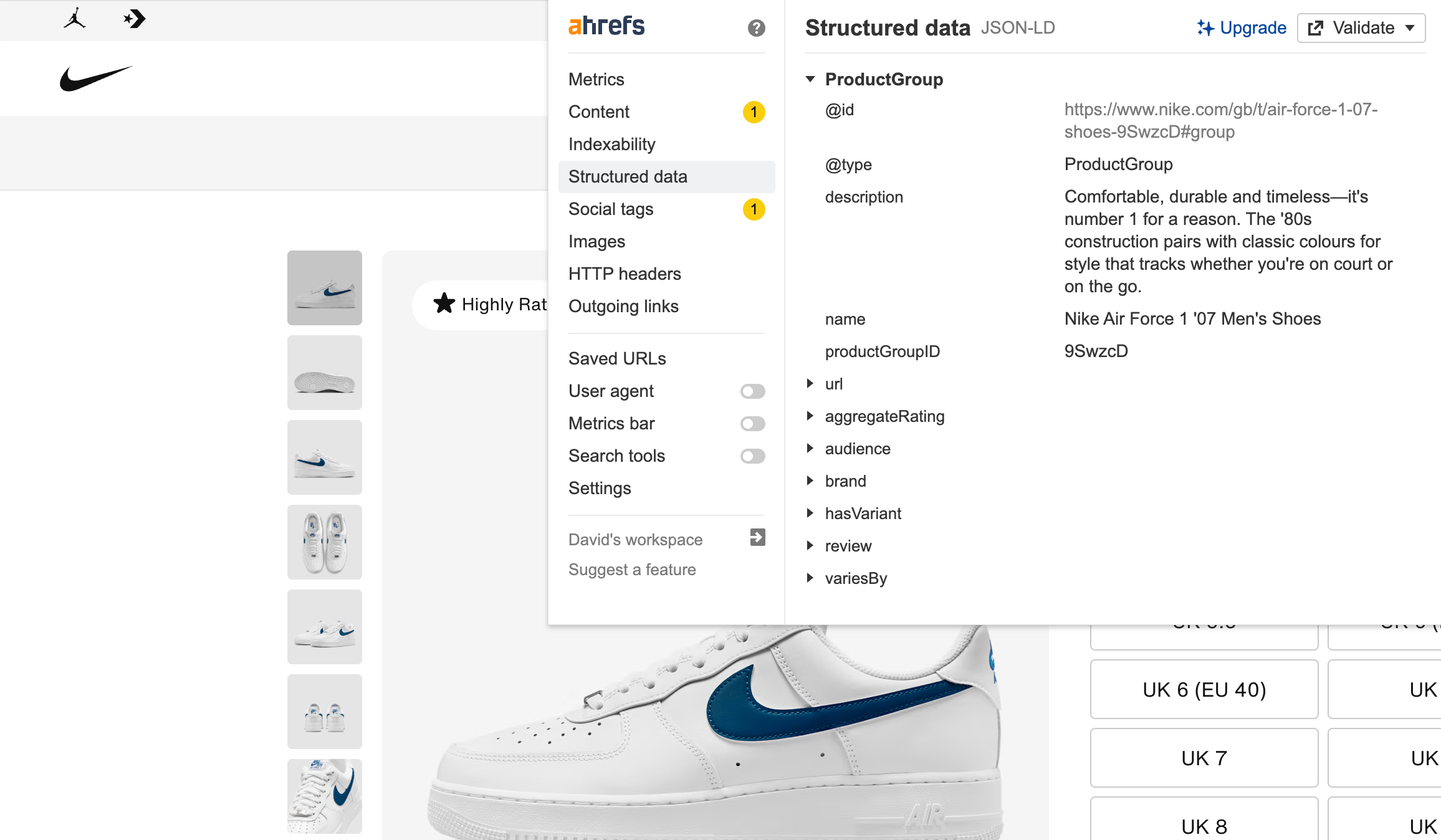
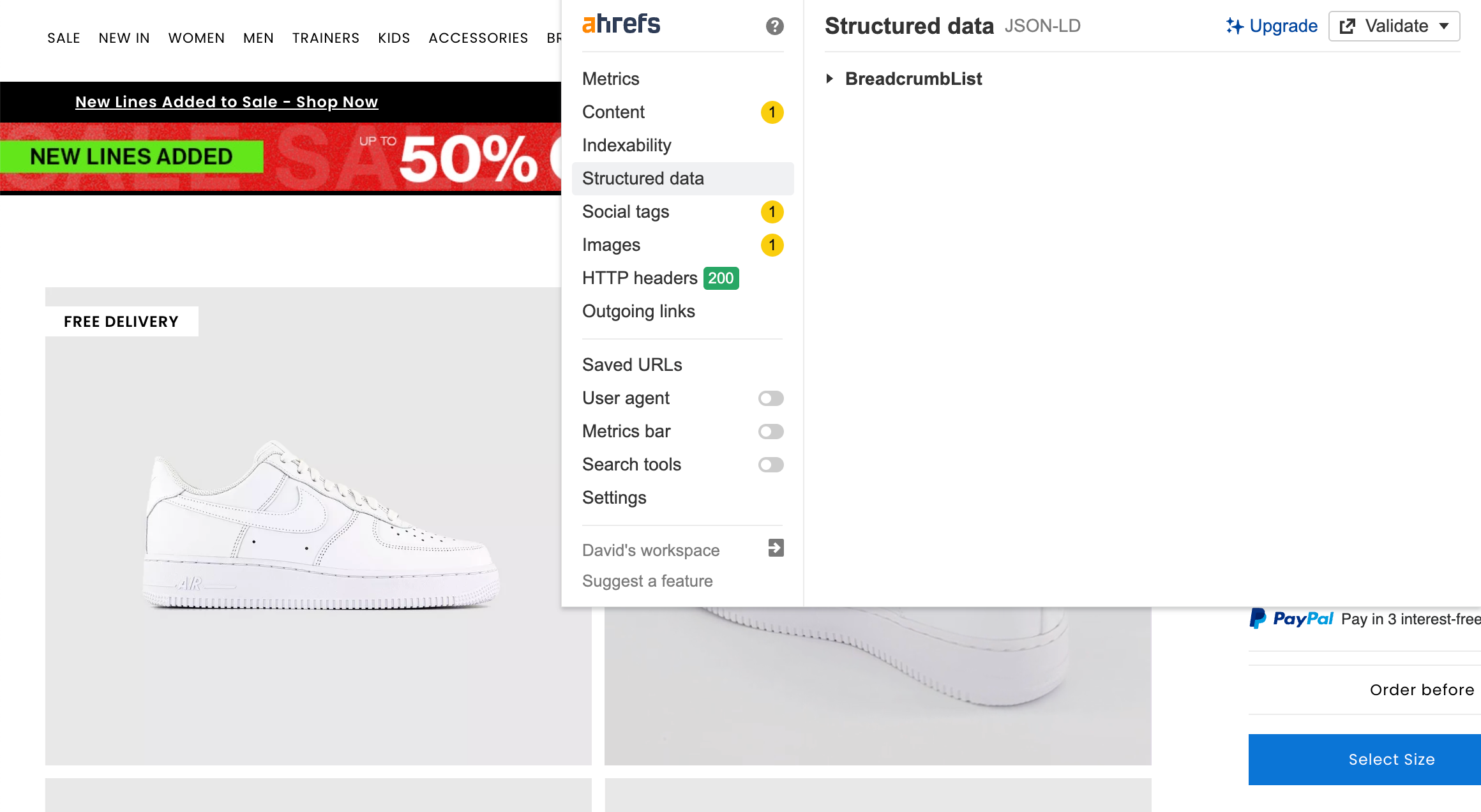
- Ask your ecommerce platform and payment processors about their plans and timelines to support agentic commerce. Some providers, like Shopify, have announced partnerships with OpenAI and participated in the launch of UCP. However, details are sparse and it's unclear what exactly they'll offer their merchants. Our guess is it will be similar to traditional search: just like your ecommerce provider can get you indexed on Google, they will get you on ChatGPT. However, optimizing your listings and boosting your AI chat ranking will be up to you.
While it is possible for businesses to host their own payment flow in Google's UCP, it will be easier to use a payment processor that supports the protocol itself. Most major processors (Visa, Mastercard, Stripe, Adyen, Amex) will support UCP.
Great: for well-resourced companies who want to dominate AI commerce
- Set up A/B and incrementality testing. No one fully knows how to get your products to the top of AI results. Just like for SEO, you'll be at the mercy of an unknown, changing algorithm.
Top merchants will win by experimenting: will feeding longer, detailed product descriptions improve or worsen results? OpenAI allows you to share three custom descriptors per product variant - which three should you pick? What's the impact of including product videos instead of just photos?
RetailQ's analytics helps you A/B test by allowing you to compare metrics like visits, conversions or checkouts between different groups (time periods, products, AI models, regions, etc). - Get your ecommerce stack ready for agentic customers with an MCP server. Google's UCP will enable AI tools to purchase your products on behalf of customers. For example, a consumer may instruct an AI to purchase either blue, green or pink shoes depending on which first goes on sale. The AI agent will track listings from different stores and make a purchase itself when appropriate.
To be ready for those scenarios, we suggest you look into the MCP and Agent-to-agent bindings (A2A) in the UCP specifications. Model Context Protocol (MCP) has become the standard way for AI tools to interact with each other. The MCP and A2A bindings will be more complex to implement and test than an API, but enable fully agentic transactions and better interoperability with existing AI tools. We'll publish a detailed explanation of the UCP soon (join the mailing list for updates)